
Final rites, family priests, and the registers that carry a family's story.
Within a longstanding Hindu pilgrimage-register tradition, many Hindu families have travelled to Haridwar, Har Ki Pauri and other sacred centres for final rites, ashes-related observances, remembrance and family duties. As part of these visits, families would often meet their family priest or purohit — and the hereditary custodian who has quietly kept their family's entries for decades, sometimes centuries. This is one longstanding Hindu tradition; practices vary between families, regions and hereditary custodians.
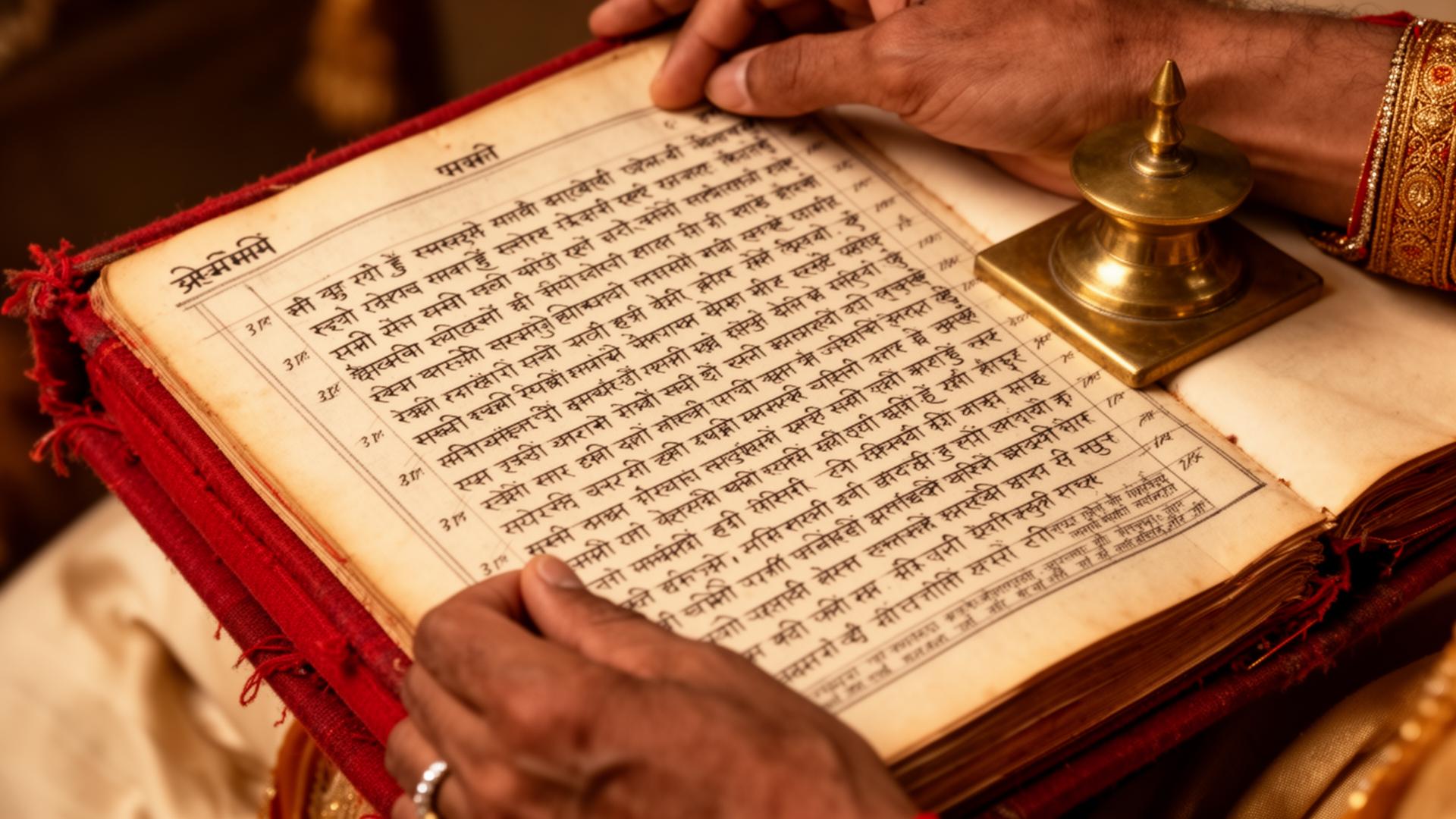
A visit that is also a record
The visit itself is often the moment the family register is updated. Major life events — a death in the family, a birth, a marriage, a name change, a new branch of the family — are spoken aloud, written down, and signed. In this way, what looks like a single ritual visit quietly becomes part of a much longer written line.
The wider family, remembered together
When one person's death, birth, or marriage is being recorded, the priest or purohit will often ask the family to recall the most complete family tree they know at that moment — parents, siblings, spouses, children, ancestral village, gotra, and any earlier generations still held in memory. That wider remembered information may also be added or refreshed in the register, so that the family line is preserved a little more clearly for the next generation that visits.
Traditions vary
No two families follow exactly the same path. Rituals, the role of the priest, the centres visited, and what is written into a register vary by region, by community, by family, and by the individual record holder. We try to describe the tradition with care, but we never claim a single, uniform practice — and we never promise an exact ritual outcome on your behalf.
Why this matters for families overseas
For families now living in the UK, North America, the Gulf and beyond, travelling to India whenever a family event needs recording is rarely practical, and many families have lost direct contact with their traditional priest. Indian Archive helps overseas families reconnect with the appropriate traditional custodian, coordinate the family information he asks for, and arrange an update where he accepts the case — without necessarily travelling to India. The priest remains the custodian of the register and decides what may be entered.
You do not need to know which priest or traditional route applies to your family before you begin. If your family already knows its Panda, Pandit or Purohit, we work through that route. If contact has been lost, we help identify and locate the appropriate traditional custodian using what your family remembers about ancestral village, district, community and gotra.
Where a family-register connection is relevant after a bereavement, identifying the custodian and following through the appropriate work forms part of Indian Archive's managed service. For a plain explanation of how these registers are organised, read our guide to how traditional Indian family registers work.
Final rites & remembrance
Visits to Haridwar, Har Ki Pauri, and other sacred centres for ashes-related rituals and family duties.
Family priest or purohit
The hereditary priest who has long served a particular community, region, or lineage.
The family register
Updated with deaths, births, marriages, and the wider family information shared at the time of the visit.
Living memory
What the family recalls in that moment becomes part of what is written down for the next generation.
Family-register work is part of the managed service
If the bereavement needs to be recorded in your family's traditional Bahi or family register, Indian Archive will contact or reconnect with the appropriate hereditary custodian, provide the relevant family and death information, and follow through on the appropriate work as part of the managed service.
Working with traditional custodians across Haridwar, Punjab, Haryana, Rajasthan, Bengal and beyond. Practices vary from one priest to another.